
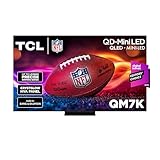
The TCL 55QM7K is a 2025 model Mini LED QLED television that sits in TCL’s premium QM7K series. It targets viewers who want near-OLED picture quality at a more accessible price point. If you’ve been researching high-brightness 4K TVs with strong local dimming and gaming-ready specs, this model deserves a close look.
You can find the TCL 55QM7K on Amazon here, where it currently ranks #10 in QLED TVs. This review breaks down what the technology actually does, who it suits best, and how it stacks up against the competition.
Quick Answer
The TCL QM7K is a strong mid-to-premium 4K Mini LED QLED TV offering up to 2,500 local dimming zones, a 120Hz to 144Hz refresh rate, anti-reflective screen, and Google TV with Dolby Atmos audio. It delivers excellent brightness and contrast for the price, making it a competitive choice for both home theater and gaming setups.
Key Takeaways
- The QM7K uses QD-Mini LED technology, combining quantum dot color with precise backlight control for deep blacks and vivid highlights
- Up to 2,500 local dimming zones deliver highly controlled contrast with minimal blooming
- The panel supports a 120Hz to 144Hz refresh rate, making it suitable for console and PC gaming
- The CrystGlow HVA anti-reflective panel keeps the image visible in bright rooms
- Google TV is built in, with Alexa voice control and a dedicated voice remote included
- Onkyo-tuned audio with Dolby Atmos support improves built-in sound quality above average TV speakers
What Is QD-Mini LED Technology?
QD-Mini LED combines two separate display advancements into one backlight system. “Mini LED” refers to using thousands of much smaller LEDs as the backlight source instead of conventional large LEDs. “QD” stands for quantum dot, a layer that enhances color accuracy and saturation.
Together, these technologies allow the TV to control brightness at a much finer level than standard LED TVs. The result is deeper blacks in dark challenge in HDR content.
How the Halo Control System Works
TCL’s Halo Control System is the engineering suite behind the QM7K’s backlight management. It includes several components working together:
- Super High Energy LED Microchip increases per-zone brightness output
- Super Condensed Micro Lens focuses light more precisely to reduce spill
- Micro-OD Reduced Optical Distance brings LEDs closer to the panel for tighter light control
- Bi-direction 23-bit Backlight Controller enables more precise dimming steps
- Dynamic Light Algorithm adjusts zones in real time based on scene content
The practical outcome is what TCL calls “halo-free” images, meaning bright objects on dark backgrounds should not produce the glow or halo effect that plagues many LED TVs.
Picture Quality Features
Local Dimming: Up to 2,500 Zones
The LD2500 Precise Dimming Series gives the QM7K up to 2,500 independently controlled dimming zones. More zones mean finer control over which parts of the screen are bright or dark at any given moment.
For context, many mid-range LED TVs offer fewer than 500 zones. Reaching 2,500 zones puts the QM7K in a category that more closely competes with premium OLED-alternative displays.
HDR Brightness Performance
High HDR brightness is one of the QM7K’s advertised strengths. Strong peak brightness matters for HDR content because it determines how bright specular highlights, sunlight, and bright objects appear on screen.
The QM7K is designed to perform well in virtually any room lighting environment, which is a practical advantage for living rooms with windows or overhead lighting.
CrystGlow HVA Anti-Reflective Panel
The CrystGlow HVA panel addresses one of the most common complaints about bright TVs: glare. A high-brightness display is only useful if you can actually see the image clearly.
The HVA (High Vertical Alignment) panel type combined with anti-reflective coating blocks ambient reflections without significantly dulling the image. This is a meaningful feature for daytime viewing or rooms where controlling light is difficult.
Gaming and Refresh Rate
The QM7K supports a 120Hz to 144Hz refresh rate, which covers the needs of most current-generation gaming setups. The PS5 and Xbox Series X both support up to 120Hz, and a 144Hz ceiling gives PC gamers additional headroom.
Zero Delay Transient Response is another feature in the Halo Control System that reduces backlight response lag, which matters during fast-moving scenes in games or sports. For anyone building a dual-purpose home theater and gaming setup, the QM7K’s spec sheet is well-suited to that use case. If you’ve ever wondered why your 144Hz monitor is only showing 60Hz, the same cable and settings principles apply when connecting gaming devices to high-refresh TVs.
Smart TV Platform and Audio
Google TV
The QM7K runs Google TV, which is one of the more capable smart TV platforms available. It aggregates content from streaming services into a unified interface, supports Google Assistant, and allows app installation from the Google Play Store.
Alexa voice control is also built in, and the included voice remote lets you control the TV, search for content, and manage smart home devices hands-free.
Onkyo Audio with Dolby Atmos
TCL partnered with Onkyo to tune the built-based audio processing for a more dimensional sound experience from the TV’s own speakers.
Built-in TV audio rarely matches a dedicated soundbar, but Onkyo tuning and Dolby Atmos support put the QM7K’s audio above most TVs in this price range.
TCL QM7K vs. Competitors
The QM7K competes directly with Samsung’s QN85B/QN90 Neo QLED series and the Hisense U8 series. Here is how the key specs compare across similar 55-inch models.
| Feature | TCL QM7K (55″) | Samsung QN85B Neo QLED | Hisense U8N |
|---|---|---|---|
| Backlight Type | QD-Mini LED | Neo QLED ( zones | Up to 1,376 zones |
| Refresh Rate | 120Hz – 144Hz | 120Hz | 144Hz |
| Anti-Reflective Panel | Yes (CrystGlow HVA) | Yes | Yes |
| Smart Platform | Google TV | Tizen | Google TV |
| Dolby Atmos Audio | Yes (Onkyo) | Yes | Yes |
| HDR Support | HDR10, Dolby Vision | HDR10+, HDR10 | Dolby Vision, HDR10+ |
Compared to the Samsung QN85B, the TCL QM7K offers significantly more local dimming zones, which gives it a notable contrast advantage in dark scenes. The Samsung platform (Tizen) is well-regarded, but Google TV is equally capable for most users.
Vs. the Hisense U8N, the QM7K’s dimming zone count is higher, though both are strong performers in the Mini LED category. The Hisense U8N has historically offered competitive brightness, so real-world performance between these two is close. TCL’s Halo Control System and Onkyo audio tuning are differentiators worth considering. Understanding how TV shows influence what we watch and how we experience content also reinforces why display quality matters more than ever for immersive viewing.
Conclusion
The TCL QM7K is a technically capable 2025 Mini LED QLED TV that delivers premium picture features at a competitive price. Its 2,500 local dimming zones, anti-reflective HVA panel, and 144Hz refresh rate make it suitable for both home theater and gaming use. The Google TV platform and Onkyo-tuned Dolby Atmos audio round out a well-balanced package.
It is not the right choice for those who prioritize perfect black levels in a completely dark room, where OLED still holds an edge. But for most living room environments and mixed-use setups, the QM7K delivers strong value. You can check current pricing and availability for the TCL 55QM7K on Amazon.
Frequently Asked Questions
What is the difference between QD-Mini LED and OLED?
QD-Mini LED uses a backlight system with thousands of small LEDs and quantum dot color enhancement, while OLED uses self-emitting pixels that turn off completely for true black. OLED achieves perfect blacks but QD-Mini LED can reach higher peak brightness levels.
Does the TCL QM7K support 4K at 120Hz or 144Hz?
Yes, the QM7K supports up to 144Hz at 4K resolution, making it compatible with high-refresh gaming from both consoles and PCs via HDMI 2.1 ports.
Is the TCL QM7K good for bright rooms?
Yes. The CrystGlow HVA anti-reflective panel and high HDR brightness make the QM7K one of the better options for rooms with significant ambient light or windows.
What smart TV platform does the TCL QM7K use?
The TCL QM7K runs Google TV, which supports Google Assistant, Alexa, app downloads from the Google Play Store, and content aggregation across streaming services.
How many local dimming zones does the TCL QM7K have?
The TCL QM7K features up to 2,500 precisely controlled local dimming zones through its LD2500 Precise Dimming Series, which is significantly higher than most competing TVs in its price range.
This article was last updated on May 25, 2026 .
